
To learn Spanish vocabulary from scratch, combine a useful word list with regular recall practice and examples you understand. A premade Anki deck can organize the study and review. Short readings and simple sentences about your own life show you how to use the words beyond a card.
Start with vocabulary you can use at home: asking where something is, describing a room, preparing food. Use these situations to choose words and practice messages before you need a conversation partner.
Which Spanish words should you learn first?
Begin with common words and expressions, then add vocabulary for things you actually do. Greetings, question words, and everyday verbs belong alongside the names of objects around you.
For home life, a small selection might include:
- la puerta — the door
- la llave — the key
- la mesa — the table
- el vaso — the glass
- abrir — to open
- cerrar — to close
- buscar — to look for
- limpiar — to clean
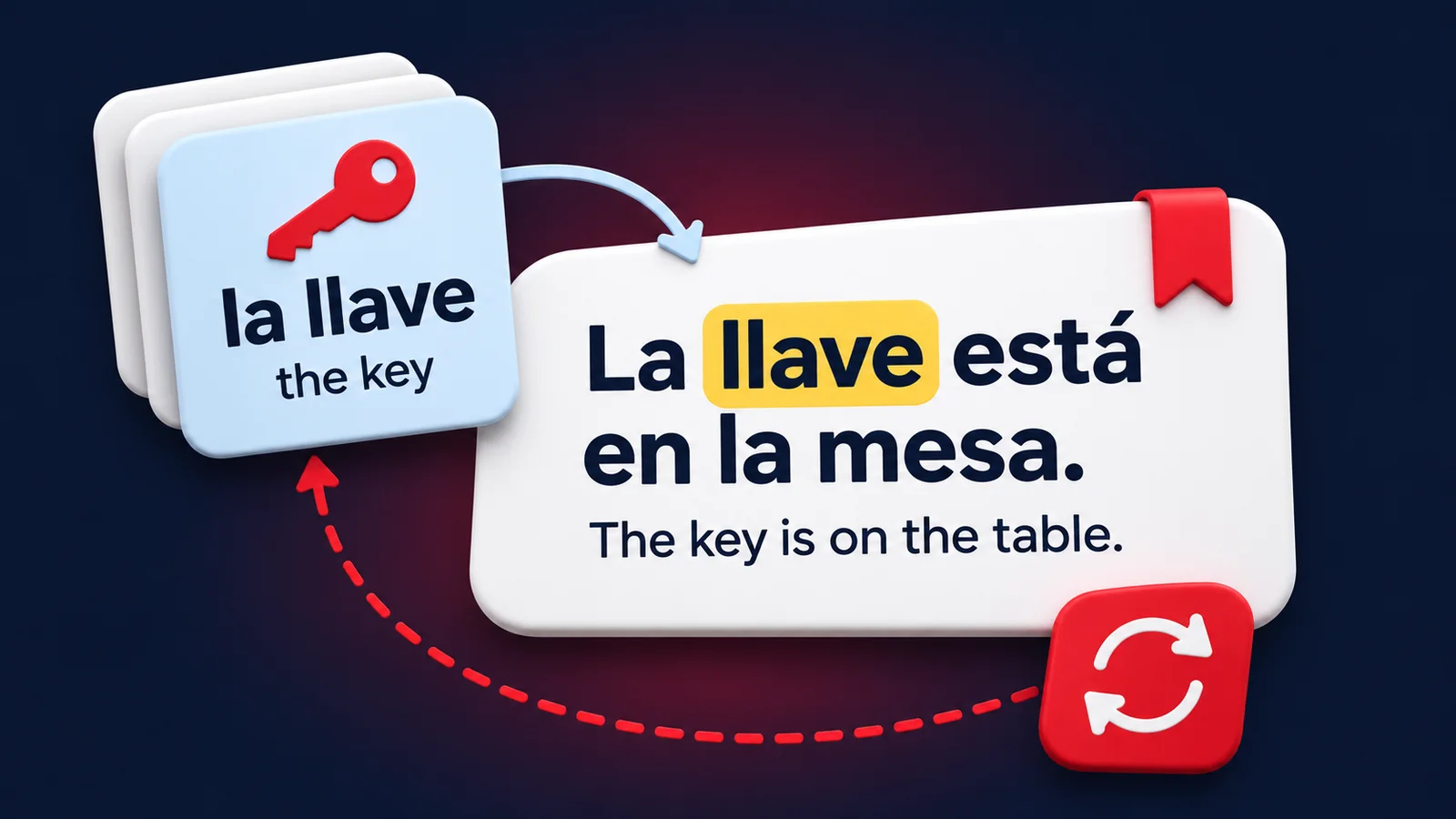
Now connect them to messages: ¿Dónde está la llave? means “Where is the key?” Quiero un vaso means “I want a glass.” You can learn these examples while you gradually work out the grammar behind them.
Object names are only part of a useful beginner selection. Add words that help you ask and describe: dónde for “where,” aquí for “here,” and a model such as Hay una mesa — “There is a table.” If your list contains only furniture and kitchen equipment, you will soon need help connecting those nouns. Keep a few basic sentence models beside the words you study.
A frequency list can help you find common vocabulary. Before adding an unfamiliar item to your study, check whether you can understand its meaning in an example. Keep a word that helps you describe breakfast or ask for something. Set aside a specialist term you have no immediate use for.
Some frequent words need more explanation. Que, for example, appears in many structures; a single translation cannot show all its uses. Learn one understandable example at a time instead of trying to memorize every dictionary meaning.
For nouns, keep the article: la mesa, el vaso. For verbs, include a short example: Busco la llave — “I’m looking for the key.” This gives you a form you can say, even if you have only just encountered the infinitive buscar.
How the main vocabulary methods compare
Word lists, flashcards, and reading serve different purposes. In his guide to learning a foreign language, Paul Nation recommends balancing deliberate study with listening, reading, speaking, and writing. He also explains the roles of spaced repetition and retrieval: trying to recall something you have previously learned.
For a beginner choosing how to study, the practical differences are these:
| Method | Useful for | Limitation to account for |
|---|---|---|
| Vocabulary lists | Finding a manageable selection of words | Reading down a list leaves the answers visible |
| Premade Anki decks | Starting with prepared material and organizing review | Cards may assume knowledge you do not have |
| Reading and listening | Meeting words in sentences and recognizing their uses | Difficult material can demand constant lookups |
| Personal sentences | Practicing messages you want to communicate | A beginner may need a model or help checking accuracy |
Use Anki as the main review tool, then give part of your study time to understanding and using its vocabulary. You can also keep a few personal words beside the deck: the things you keep wanting to say at home.
Choose one premade Anki deck
A premade deck saves you from writing every card before you can start studying. Choose one aimed at English speakers learning beginner Spanish. A large vocabulary collection can wait until you understand how its cards are organized.
Free shared decks or a paid deck?
For a free option, start with Anki’s shared-deck catalog and search for beginner Spanish or Spanish frequency vocabulary. The official Anki instructions for shared decks explain how to find a deck through “Get Shared,” download the package, and import it. The manual also cautions that another learner’s cards can lack explanations their creator already knows.
A paid example is Refold’s Spanish 1K Anki deck. Its product page describes a selection of 1,000 vocabulary items with example sentences and native-speaker audio. Refold distinguishes the downloadable Anki purchase from its browser-based subscription, so check which product you are choosing.
Treat a paid deck as a candidate to inspect. Decide whether its examples are understandable and its selection fits what you want to learn. A free deck with clear cards may suit you better than a paid one whose sentences require constant explanation.
What to inspect before committing
Preview cards from different parts of the deck. Look for:
- A precise meaning. The translation should fit the example, especially for words with several meanings.
- Articles with nouns. You should be able to learn la llave together.
- Understandable sentences. A new word is difficult to study when the surrounding sentence is also unfamiliar.
- Usable audio. Check that you can hear the word clearly and identify what the recording corresponds to.
- A sensible order. The early cards should give you an accessible starting point.
Try explaining a sample card in plain English. If you cannot tell what the Spanish sentence means, find an explanation before reviewing it repeatedly. For example, knowing puerta means “door” does not explain every other word in a long sentence about entering a house.
Choose the deck you can understand and work through consistently. Compare additional decks only when you can identify something specific your current material is missing.
Review cards with an answer in mind
When Anki shows a prompt, attempt the answer before revealing it. Its basic review system lets you report how well you remembered the answer and uses that response to schedule the card again.
For a card showing la llave, try to recall “the key.” Listen to any available recording and say the Spanish aloud. When a card asks for Spanish, attempt the Spanish word before checking.
These directions practice different tasks. Understanding la llave when it appears is useful for reading. Producing it from “the key” is closer to choosing a word while speaking.
Check which direction your premade deck uses. If it mainly tests understanding, add a brief spoken check after the review: look at an object nearby and try to name it in Spanish. Keep the task small enough that you can check the answer accurately.
Start with five new cards a day as a trial workload. Adjust that number to the time you have and the difficulty of the cards. Finish the reviews already waiting before introducing more. If they become hard to manage, reduce new cards while you catch up.
Also distinguish cards from words. A deck may create multiple cards for one vocabulary item, such as a Spanish-to-English card and an English-to-Spanish card. Track the messages you can understand and produce alongside the number of cards completed.
Fix the words you keep forgetting
Repeated mistakes are a reason to inspect the item. Ask what makes the answer difficult to retrieve.
A card with banco and the answer “bank” needs an example to clarify the intended meaning; banco can also mean “bench.” A sentence containing several unfamiliar words may need to be simplified. Two similar words may need separate, clearer examples.
For household vocabulary, compare limpiar and cocinar through distinct actions:
Limpio la mesa. — I clean the table.
Cocino en casa. — I cook at home.
Picture the action each sentence describes. Then hide the Spanish and try the appropriate sentence from its meaning. If you still confuse the words, return to one example at a time.
Check whether the prompt allows several answers. “Glass” could refer to a drinking container, un vaso, or the material, el vidrio. A clearer prompt such as “a glass for drinking water” tells you which meaning to retrieve. The same check applies to a word you add yourself: imagine seeing the card next week, without remembering what you meant when you wrote it.
Keep the answer tied to the meaning you are practicing. If you can remember an English translation but cannot understand the Spanish example, spend time on the example before adding more vocabulary.
Use reading to meet your vocabulary again
After studying household words, choose a short beginner text about a home or daily routine. Look for a few familiar items and see what surrounds them.
Here is a practice example:
Estoy en casa. Busco la llave. La llave está en la mesa, junto a un vaso.
“I’m at home. I’m looking for the key. The key is on the table, next to a glass.”
The text brings together words you have studied. It also introduces junto a — “next to” — through a situation you can picture. If the phrase is useful, keep the whole expression with its example. Other Spanish chunks can be studied this way too.
With Spanish–English parallel texts, try the Spanish first and check the English when a sentence blocks your understanding. Then reread the Spanish. Choose an easier text if you need help with nearly every sentence.
Reading lets you recognize familiar vocabulary in context. To add a recall check, close the text and try saying where the key was. You can check both the word and the sentence against the original.
Say something about your own home
Use an example as a model before attempting a complicated description. From La llave está en la mesa, you could produce El vaso está en la mesa — “The glass is on the table.”
Change one detail you understand. Check the noun’s article and the meaning of the complete sentence. If a change requires grammar you have not learned, get help checking it rather than assuming every word can be swapped freely.
Try saying the message when you see the object. Later, attempt it again without looking at the model. You now have a concrete check: can you communicate where something is?
For your next selection, open the A1 Spanish vocabulary list and find “Home and everyday objects.” Choose five unfamiliar items you expect to use, read their examples, and check whether your Anki deck already includes them. Add only the missing items you understand, then practice one short message about your own home.