
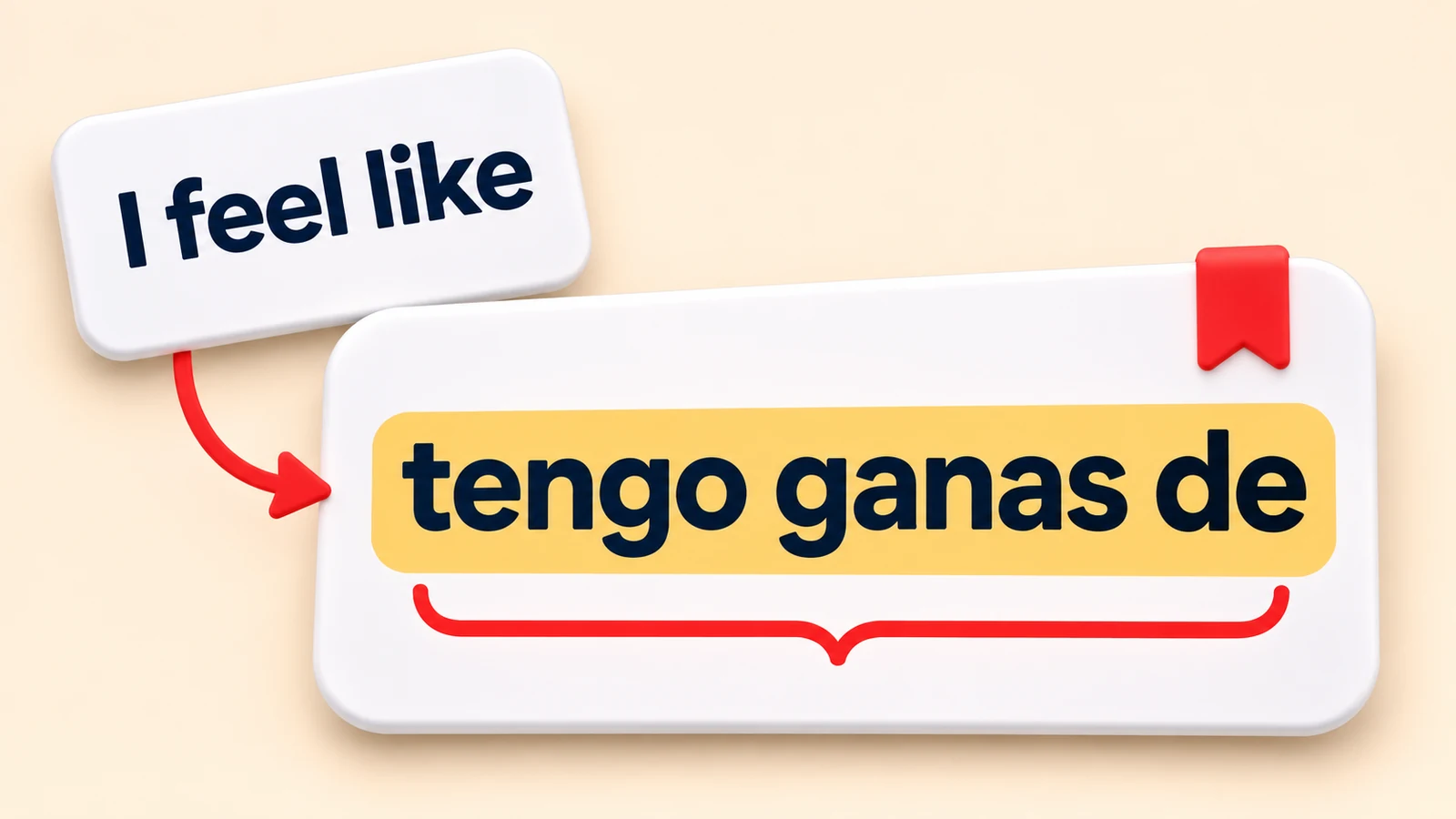
A Spanish chunk is a group of words that speakers use together as one piece: ¿qué tal?, tengo que irme, ¿me trae la cuenta? When you learn the whole phrase, you can say it without building it word by word, and you avoid most of the mistakes that come from translating English directly.
This guide explains what counts as a chunk, shows a simple way to study them, and then lists useful chunks grouped by situation.
What a chunk is in Spanish
Take the English sentence “It’s cold.” If you build it word by word, you might say es frío or está frío. Spanish speakers say hace frío. Learn hace frío as one unit and the problem disappears.
Chunks come in a few shapes:
- Fixed expressions that never change: de nada, por cierto, ¡no me digas!
- Collocations, words that usually go together: tomar una decisión, hacer una pregunta, pedir perdón. English uses “make” for the first two, which is why learners often say hacer una decisión.
- Frames with a slot, where one part changes: tengo ganas de ___, ¿te importa si ___?, acabo de ___.
Linguists call this formulaic language. In his paper Learning language in chunks for Cambridge, Scott Thornbury quotes Alison Wray’s definition: sequences that appear to be “stored and retrieved whole from memory”. The same paper reports a frequently cited estimate that nearly 60% of spoken language is formulaic to some degree. That figure comes from research on English, so read it as a sign of how much everyday speech is reused, not as a measurement of Spanish.
Chunks don’t replace grammar. They give you correct sentences to use while your grammar catches up.
How to learn Spanish in chunks
Find chunks in what you read
The easiest chunks to spot are the ones that don’t translate word for word. When the English version of a sentence looks nothing like the Spanish, you have probably found one.
Spanish–English parallel texts make this easy because each Spanish paragraph sits next to its translation. If you read tengo ganas de salir and the English says “I feel like going out”, mark tengo ganas de as a chunk. A literal translation (“I have desires of”) would never get you there.
Pick three to five chunks per text. Choose the ones you could use this week, not the most unusual ones.
Put the whole chunk on a flashcard
Anki or any flashcard app works well for chunks, as long as the card holds the phrase and not a single word.
A weak card:
- Front: ganas
- Back: desire
A useful card:
- Front: I feel like going out tonight.
- Back: Tengo ganas de salir esta noche.
Put the English on the front and the Spanish on the back. That direction trains you to produce the phrase, which is what you need when speaking. Recognizing tengo ganas de when you read it is easier and will come anyway.
If you use Anki, cloze cards are another option. Write the full Spanish sentence and hide the chunk: {{c1::Tengo ganas de}} salir esta noche. You see the context and have to recall the missing phrase.
Keep each card to one chunk and one short sentence. Long cards with several new phrases are harder to review and easier to skip.
Swap one piece and reuse it
A frame becomes yours when you change the slot:
- Tengo ganas de comer algo.
- Tengo ganas de verte.
- No tengo ganas de trabajar hoy.
Say each version out loud, then write one sentence about your own life. A personal sentence gives the chunk a context you’ll remember.
Spanish chunks list by situation
The phrases below are neutral Spanish that works in most countries. When a region uses a different everyday version, the note column says so.
Greetings and small talk
| Spanish | English | Note |
|---|---|---|
| ¿Qué tal? | How’s it going? | Used everywhere. ¿Qué onda? is a casual version in Mexico and parts of Latin America. |
| ¿Cómo te va? | How are things? | |
| Mucho gusto. | Nice to meet you. | In Spain, encantado / encantada is very common. |
| ¡Cuánto tiempo! | Long time no see! | |
| Nos vemos. | See you. | |
| Que te vaya bien. | Take care. / Hope it goes well. |
Asking for things
| Spanish | English | Note |
|---|---|---|
| ¿Me trae la cuenta? | Could you bring me the check? | |
| Quisiera… | I’d like… | Polite in shops and restaurants. |
| ¿Me da…? | Can I have…? | In Spain, ¿Me pone…? is the usual way to order: ¿Me pone un café? |
| ¿Cuánto cuesta? / ¿Cuánto es? | How much is it? | ¿Cuánto es? is common when paying the total. |
| ¿Dónde está…? | Where is…? | ¿Dónde queda…? is very common in Latin America. |
| ¿Me puedes ayudar? | Can you help me? | |
| ¿Te importa si…? | Do you mind if…? |
Reacting
| Spanish | English | Note |
|---|---|---|
| ¡Qué bien! | That’s great! | |
| ¡Qué pena! / ¡Qué lástima! | What a shame! | |
| ¡No me digas! | No way! / You’re kidding! | |
| No pasa nada. | It’s fine. / No worries. | |
| Me da igual. | I don’t mind. | |
| Está bien. | OK. | Vale in Spain, dale in Argentina, Uruguay and several other countries, órale in Mexico. |
| ¡Qué bueno! | Cool! / Great! | Regional versions: ¡qué padre! (Mexico), ¡qué chévere! (Colombia, Venezuela, the Caribbean), ¡qué guay! (Spain). |
Giving your opinion
| Spanish | English |
|---|---|
| Creo que… | I think… |
| Me parece que… | It seems to me… |
| Estoy de acuerdo. | I agree. |
| No estoy seguro / segura. | I’m not sure. |
| Tienes razón. | You’re right. |
| Depende de… | It depends on… |
| Lo que pasa es que… | The thing is… |
Tienes razón is a good example of why chunks matter: English uses “to be” (“you are right”), Spanish uses tener.
Plans, needs and obligations
| Spanish | English | Note |
|---|---|---|
| Tengo que… | I have to… | |
| Tengo ganas de… | I feel like… | |
| Voy a… | I’m going to… | |
| Acabo de… | I’ve just… | Acabo de llegar = I’ve just arrived. |
| Me toca a mí. | It’s my turn. | |
| Hace falta… | … is needed. / We need… | |
| ¿Quedamos el sábado? | Shall we meet on Saturday? | Mainly Spain. In Latin America, ¿Nos vemos el sábado? is more common. |
Connecting ideas
These chunks make your Spanish sound less like a list of separate sentences.
| Spanish | English |
|---|---|
| Es que… | The thing is… / It’s just that… |
| Por eso | That’s why |
| Sin embargo | However |
| O sea | I mean / In other words |
| A lo mejor | Maybe |
| Por cierto | By the way |
| Al final | In the end |
Time and weather
| Spanish | English | Note |
|---|---|---|
| Hace frío / Hace calor | It’s cold / It’s hot | Weather uses hacer, not ser or estar. |
| Hace dos años | Two years ago | |
| De vez en cuando | From time to time | |
| Todos los días | Every day | |
| Ahora mismo | Right now | Ahorita is common in Mexico and Central America, and its meaning can stretch from “right now” to “in a while”. |
| Dentro de una semana | In a week |
Where to start
Don’t try to learn every table at once. Pick the situation you face most often, such as ordering food or chatting with a coworker, and turn five of its chunks into flashcards this week.
Then read one of the Spanish–English parallel texts at your level and look for those chunks, plus any new ones the translation gives away. Add those to your deck, and the next text will be a little easier to read.